Roof Repairs
Repairs across Hornsby and the Upper North Shore, where gutters and valleys blocked under heavy canopy cause most water entry.
Learn more →Colorbond and metal roofing for Hornsby, Berowra, Arcadia and Brooklyn. Profiles, insulation, ember detailing and honest advice on tile versus metal.
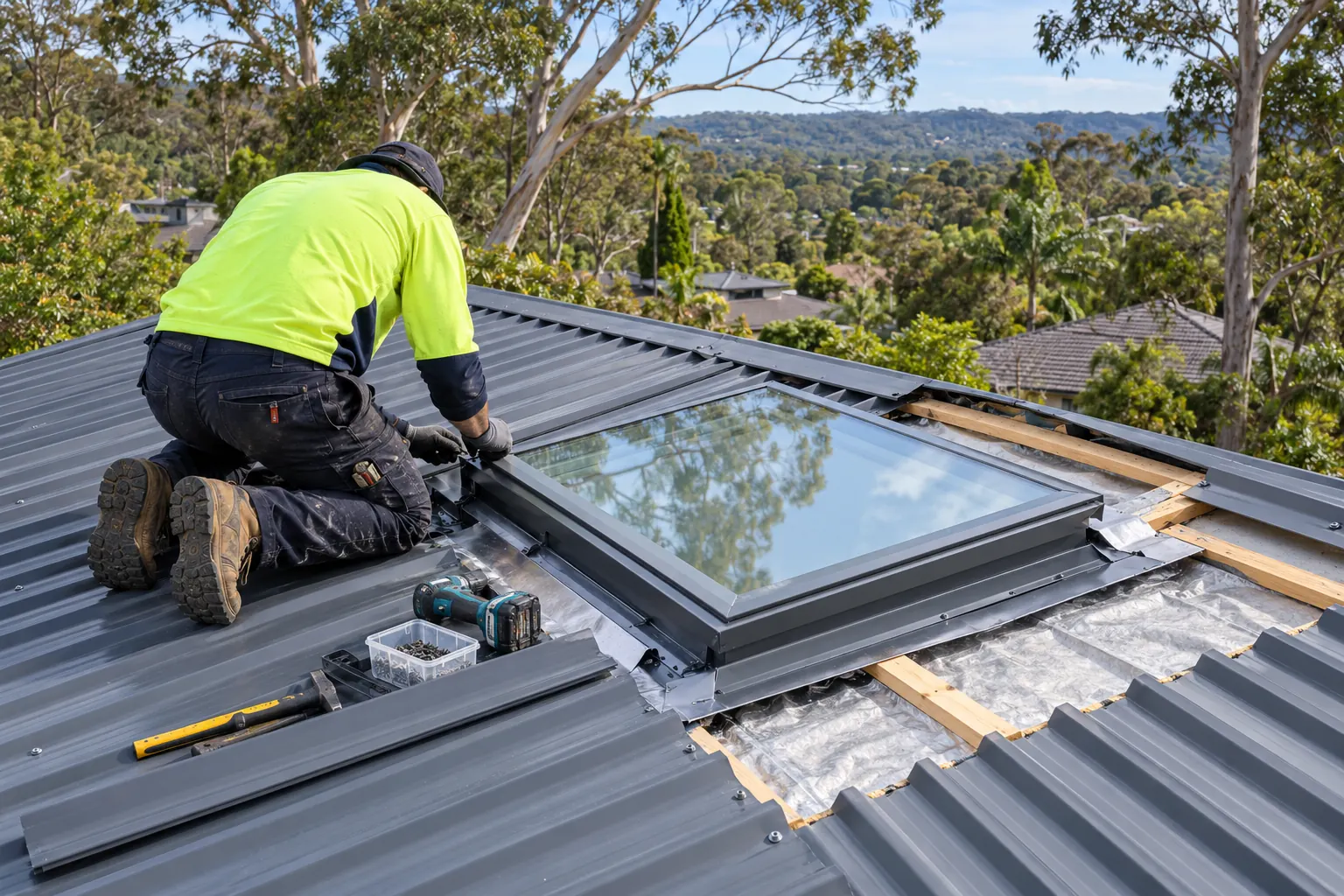
Metal roofing makes a lot of sense on a bushland block. Leaves slide off it instead of lodging in tile laps, it is light on tired framing, it handles the low pitches on 1960s and 70s houses, and it can be detailed cleanly for ember protection.
We install and replace Colorbond and other coated-steel roofing across Hornsby, the Upper North Shore and down to the Hawkesbury. Free inspection, written quote, no obligation. (02) 9000 1127.
Three local conditions push people towards metal:
Canopy. Around two-thirds of Hornsby Shire is bushland and the housing sits inside it. A smooth profile sheds litter that a tile roof holds.
Terrain. Steep blocks dropping away toward the Berowra Valley or the Hawkesbury make scaffolding and access expensive. Fewer components and faster laying time help.
Fire planning. On land mapped as bushfire prone, a non-combustible covering with sealed junctions and fine ember mesh is a straightforward thing to achieve with sheet roofing.
That is not an argument that everyone should rip off their tiles. On a heritage street in Beecroft or Cheltenham, matching the existing roofline matters, and a tile restoration will often be both cheaper and more appropriate.
Minimum pitch matters more than people expect. A profile laid flatter than it is rated for will hold water at the laps and will eventually leak, no matter how good the sheet is.
A metal roof is a system, and most of its performance comes from what you cannot see:
Skimping on any of these is how a new roof ends up with condensation staining a ceiling that never leaked before.
Brooklyn sits on the Hawkesbury at the northern edge of the Shire, and the estuary environment there is genuinely more aggressive than it is up on the plateau at Hornsby or Thornleigh. Salt-laden air accelerates coating breakdown, concentrates in sheltered areas that rain never washes, and attacks incompatible fixings first.
For riverside and exposed-estuary houses the answer is a specification suited to that exposure, consistent metals throughout the roof and gutter system, and a maintenance expectation that includes washing down the parts the rain misses. We will say so plainly at the quote rather than selling you an inland product.
Call (02) 9000 1127 to talk through a waterfront or near-water roof.
On bushfire-prone land, AS 3959 drives the detail. For sheet roofing that means full sarking, sealed roof-to-wall junctions, no unprotected gaps at ridge or barge, non-combustible valley and gutter guards, and ember mesh with a fine aperture rather than an ordinary plastic guard. Hornsby Shire's bushfire prone land mapping is certified by the NSW Rural Fire Service and is the starting point for whether any of this applies to your address.
Metal roofing is priced on area, pitch, profile, the complexity of the roof shape and access. A simple gable over a single-storey house at Asquith is at one end; a cut-up hipped roof with four valleys, three skylights and a two-storey fall away on a Hornsby Heights block is at the other. Removal and disposal of the old covering, structural repairs and bushfire detailing all move the figure.
We quote in writing after looking at the roof, itemised, and the inspection costs nothing. Completed work carries a written workmanship warranty, and the roofing contractors doing it are licensed and insured and work to NSW Fair Trading requirements.
From Hornsby and Waitara out to Westleigh and Thornleigh, north through Mount Colah, Berowra and Cowan, and across the rural blocks at Arcadia and Fiddletown. See the full service areas list.
Ring (02) 9000 1127 or ask for a quote and tell us what is on the roof now.
Repairs across Hornsby and the Upper North Shore, where gutters and valleys blocked under heavy canopy cause most water entry.
Learn more →Full re-roofing for Federation and mid-century homes on the large treed blocks around Hornsby.
Learn more →Restoration for Hornsby tile roofs carrying years of leaf debris, moss and perished pointing.
Learn more →Gutter replacement and ember-rated leaf guard across Hornsby, where leaf load and bushfire risk are the same job.
Learn more →Storm and fallen-limb response across Hornsby and the Upper North Shore, make-safe first.
Learn more →Roof inspections and written reports across Hornsby, including gutter and roof-line assessments at the bushland interface.
Learn more →It is different rather than uniformly worse, and the fit-out decides it. Sheet laid directly on battens over an open roof space is loud. Sheet over sarking with a blanket or bulk insulation above a lined ceiling is close to unremarkable, and most people stop noticing within a week. If rain noise matters to you, say so at the quote stage and the build-up gets specified around it rather than apologised for afterwards.
They collect less and they clear themselves more readily. A smooth corrugated or trapezoidal profile sheds litter that would otherwise sit in the lap of a tile and rot there. What does not change is the gutter: on a block with eucalypts overhead the gutters still fill, so metal roofing and a properly specified leaf guard belong in the same conversation.
Yes, and it should be taken seriously rather than waved away. Marine and estuarine environments shorten the life of standard coated steel and punish the wrong fastener choice badly, so near the river the specification moves to a product rated for that exposure, with compatible fixings and flashings. Mixing metals on a waterfront roof is how you get corrosion in three years instead of thirty.
We do not recommend it on these houses. Laying over the top traps moisture, hides the condition of the battens and sarking, and leaves a heavy redundant layer on framing that may already be tired. Stripping back lets us see and repair the structure, install sarking correctly and detail the valleys and junctions properly, which is where roofs actually leak.
All the current coated-steel colours are durable; the practical difference is heat and how much the roof reads from the street. Lighter colours reflect more and keep the roof space cooler, which matters on an exposed ridge-top block at Cowan or Mount Kuring-gai. Darker charcoals suit the bushland setting and the mid-century houses here, and pair well with added roof-space insulation.
Tell us what you need and we'll get straight back to you. Prefer to talk? Call (02) 9000 1127 and speak to someone local.
Call (02) 9000 1127