Roof Replacement
Full re-roofing for Federation and mid-century homes on the large treed blocks around Hornsby.
Learn more →Leak tracing and roof repairs across Hornsby, Wahroonga, Berowra and Brooklyn. Tiles, valleys, flashings and ridge caps. Free inspection, written quote.
Water coming through a downlight, a dark ring on a cornice, or a drip you only hear at night. Roof leaks on the Upper North Shore rarely announce themselves from outside, which is why the first job is finding where the water actually enters, not where it lands.
Call (02) 9000 1127 for a free inspection. Someone gets on the roof, photographs what they find, and you get a written quote with the reasoning attached.
Different leaks behave differently, and the pattern tells you a lot before anyone climbs a ladder.
This is the classic leaf-country leak. A valley half-full of gum litter or a gutter holding a wet mat copes with a short shower, then backs water up over the valley tray or behind the fascia once the rain keeps coming. The fix is drainage, not a patch.
Junctions are where roofs fail. Lead or metal flashings that were never dressed properly, step flashings that have lifted, or a mortar fillet that has cracked out will let water in at the worst possible point. Older Hornsby and Normanhurst houses with a 1980s extension are a common version of this.
That is often condensation or a slow track through sarking rather than a direct leak, and it is a different repair again. Poor roof-space ventilation under a dark tile roof will do it.
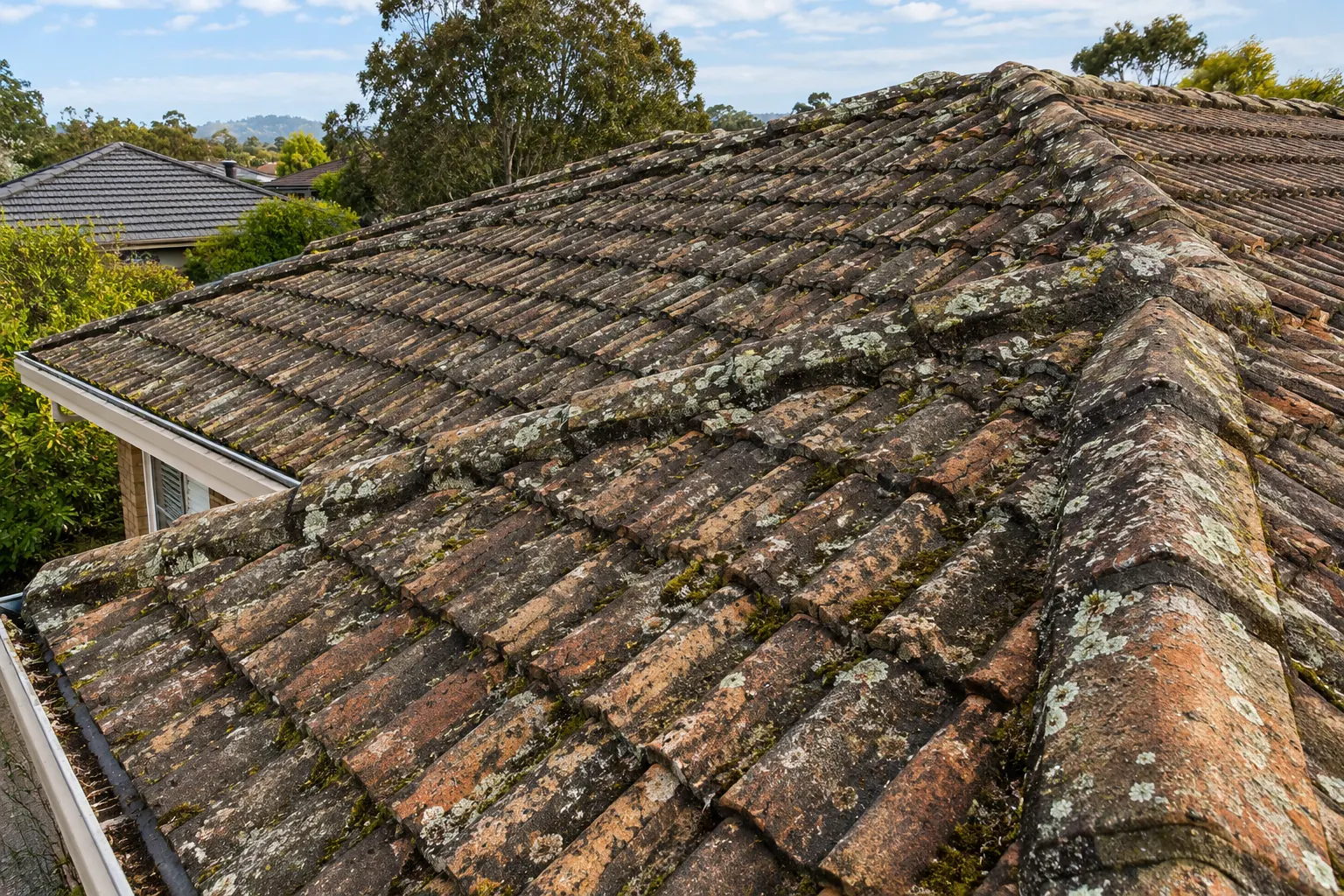
Terracotta. The inter-war and Federation terracotta over Beecroft, Cheltenham, Wahroonga and parts of Pennant Hills is tough but brittle, and it breaks under careless feet. Repairs mean walking the roof properly, replacing cracked tiles rather than sealing them, and rebedding caps with the right mortar mix.
Concrete tile. The 1960s and 70s homes through Asquith, Mount Colah, Berowra Heights and Hornsby Heights are mostly concrete. These roofs age by losing their surface coating and their pointing long before the tiles fail. Once a roof reaches that stage, a full roof restoration often costs less than repeated individual repairs.
Metal and Colorbond. Repairs here are about fixings, laps and flashings. Rusted screws, washers that have perished, sheets lifted by wind, and flashings sealed with silicone instead of being formed properly. Corrosion is worth taking seriously down at Brooklyn and along the Hawkesbury, where the air carries salt.
When water is coming in right now, the sequence is different: get it stopped, then fix it properly in dry conditions. Tarping, temporary flashing and clearing the immediate blockage are the first visit; the permanent repair is scheduled once the roof is dry enough to work on and the real extent is visible. See storm and emergency roof repairs for how that runs.
Call (02) 9000 1127 if water is coming through now.
A lot of repairs up here are really tree problems. Limbs scraping tiles loosen them, falling branches crack them, and the canopy keeps the roof permanently damp and shaded so moss and lichen take hold.
Hornsby Shire protects trees on private property through its tree and vegetation preservation controls, made under the state vegetation planning policy, and pruning or removing a tree generally needs a permit, with a short list of exempt species. So the honest advice is: do not have someone quietly take the limb off over the roof. Deal with the roof, and apply to Council separately if the tree genuinely needs work.
Nobody can price a roof repair accurately from a phone description, and anyone who does is guessing. What moves the number:
You get a free inspection and an itemised written quote before any of it starts, and completed work carries a written workmanship warranty. No pressure, no obligation, no chasing calls afterwards.
Right across Hornsby and the Upper North Shore: Hornsby and Waitara, out through Thornleigh and Westleigh, north to Mount Colah, Berowra and Cowan, and up to Brooklyn on the river.
Call (02) 9000 1127 or send the quote form and describe what you have noticed. A photograph of the stain helps more than you would expect.
Full re-roofing for Federation and mid-century homes on the large treed blocks around Hornsby.
Learn more →Colorbond roofing across Hornsby, Berowra and the Upper North Shore, including non-combustible detailing near bushland.
Learn more →Restoration for Hornsby tile roofs carrying years of leaf debris, moss and perished pointing.
Learn more →Gutter replacement and ember-rated leaf guard across Hornsby, where leaf load and bushfire risk are the same job.
Learn more →Storm and fallen-limb response across Hornsby and the Upper North Shore, make-safe first.
Learn more →Roof inspections and written reports across Hornsby, including gutter and roof-line assessments at the bushland interface.
Learn more →Usually not. Water that gets under a tile runs along the sarking, down a batten or along the top of a ceiling joist before it finds a low point and drips. On the long, shallow roof planes common on Upper North Shore houses it can travel several metres. That is why the repair starts with tracing the path from inside the roof space, not with patching the first crack we see.
Often, yes. Terracotta from the inter-war period through Beecroft, Cheltenham and Wahroonga is a finite resource, but second-hand stock in the common Marseille patterns still turns up. If an exact match is not available we will tell you, and we will usually suggest robbing matching tiles from a hidden plane and putting the odd ones there instead, so the street elevation stays consistent.
We will clear what we need to in order to see and fix the fault, but if the underlying problem is a packed valley or a gutter full of wet litter, patching a tile will not stop the leak. On heavily treed blocks we usually quote the repair and the clearing together, because doing one without the other means you will be calling again after the next long soaking.
Call (02) 9000 1127 and we will book the inspection as soon as the weather allows someone to work safely. Active water coming through a ceiling is treated as urgent and goes to the make-safe queue. A dripping tap over a bedroom at 3am is not something that waits politely for a convenient slot, and we do not treat it that way.
Routine repair and maintenance of an existing roof generally does not. Where it gets more involved is on a heritage item or inside a conservation area such as Beecroft and Cheltenham, where changing the material, profile or colour can need consent. Pruning the branches above your roof is a separate question again, and Hornsby Shire usually requires a permit for that. We will tell you which category your job sits in.
Tell us what you need and we'll get straight back to you. Prefer to talk? Call (02) 9000 1127 and speak to someone local.
Call (02) 9000 1127